Are you struggling to scale up pastry output to meet growing wholesale demands? Many facility managers invest heavily in upgraded equipment. The frustrating reality is that their target pieces-per-hour often remains out of reach. A new system alone cannot fix hidden bottlenecks. You cannot solve a mechanical limitation with just a faster conveyor belt. To truly boost speed without sacrificing that delicate artisan-level flakiness, you must evaluate specific technical specifications.
In this comprehensive guide, we break down the exact mechanical and software specs needed to maximize your hourly yield. By understanding these engineering details, you ensure your equipment investment delivers a robust and measurable return.
Key Takeaways
Throughput is a Complete System: An industrial setup is only as fast as its slowest mechanical or software component.
Lamination Width Dictates Volume: Wider dough sheets and faster servo-driven rollers exponentially increase hourly output without tearing the dough structure.
Precision Cutting Minimizes Scrap: Advanced rotary cutters reduce edge waste, directly boosting your net saleable yield.
Curling Unit Calibration is Crucial: The speed of the vacuum curling belts must perfectly match the upstream cutting stage to prevent costly jams.
Versatility Boosts Overall ROI: Equipment engineered for modular integration offers higher operational efficiency and slashes product changeover times.
Understanding Throughput in Commercial Bakery Production Lines
Throughput is the absolute heartbeat of high-volume manufacturing. Plant managers typically quantify this in two ways: pieces per hour or kilograms of dough processed per hour. Yet, raw speed means nothing if you are just producing scrap faster. Running a belt at maximum velocity only to output deformed pastries does not equate to high throughput. True factory efficiency requires a strict balance of speed, mechanical precision, and continuous operation.
Equipment manufacturers often list a theoretical maximum throughput on their specification sheets. This number represents the machinery running at full capacity under perfect conditions. Actual yield, however, is measured via Overall Equipment Effectiveness, widely known as OEE. This metric accounts for unavoidable operational realities. Scheduled maintenance, sanitation washdowns, dough resting periods, and recipe changeovers all chip away at your active runtime.
Recent industry data reveals a massive shift in the commercial baking sector. Driven by global labor shortages and fluctuating butter costs, top-tier facilities are abandoning the pursuit of sheer theoretical speed. The modern competitive landscape demands smart scaling. Facility managers are now prioritizing data-driven OEE. They look for machinery equipped with IoT sensors that monitor dough tension and fat temperature in real-time. Understanding granular specifications, like a fat pump's continuous delivery rate or a cutting cylinder's stroke capacity, is essential for eliminating these floor-level constraints.
Lamination Specs: The Engine of Your Croissant Production Line
The working width of your conveyor belts serves as the foundational specification for scaling output. Standard industrial setups typically offer working widths of 600mm, 800mm, or 1000mm. This single metric directly dictates how many pastries can be cut across the width of the line simultaneously.
Increasing this working width allows a bakery to drastically increase volume without accelerating the linear speed of the belt. Protecting the delicate gluten structure is paramount. Moving the dough too fast generates friction heat, causing the butter layers to bleed into the dough and ruining the coveted honeycomb crumb. When investing in a reliable Croissant Maker, selecting a wider belt ensures you can scale up production safely while maintaining artisan quality.
Working Width
Typical Rows (Standard Size)
Estimated Output Increase vs 600mm
600mm
4 - 5 rows
Baseline
800mm
6 - 7 rows
~40% Increase
1000mm
8 - 9 rows
~80% Increase
Continuous production relies entirely on the uninterrupted feeding of raw materials. Imagine a bustling wholesale facility during the midnight shift. If the main dough extruder operates at 1,500 kilograms per hour but the fat pump can only deliver 300 kilograms per hour, operators hit an immediate wall. They are forced to throttle the entire line to maintain the required butter ratio. Evaluating these continuous extrusion limits ensures your lamination process does not become an early-stage bottleneck.
On the mechanical side, reducing a thick block of dough into a thin laminated sheet requires immense precision. Aggressive reduction simply tears the gluten network apart. Advanced setups utilize multi-roller units and satellite heads. These feature multiple smaller rollers operating at synchronized speeds to gently stretch the dough. The reduction ratio and the RPM of these satellite heads determine exactly how fast the dough can move through the lamination phase.
Cutting and Stamping: Precision Specs for High-Volume Output
Moving beyond the sheeting phase, the cutting station is where the continuous dough band is divided into uniform triangles. The primary specification to evaluate here is Strokes Per Minute. Whether utilizing a guillotine or a rotary cutter, a higher stroke rate translates directly to more units processed. For heavy-duty industrial facilities, a specification of 100 to 150 strokes per minute is often the baseline requirement. If the cutter falls short, upstream lamination belts must be decelerated to prevent dough from accumulating and folding over itself.
The mechanical design of the cutter significantly impacts this speed limit. Traditional stamping methods operate on a rigid stop-and-go basis. The belt must pause momentarily for the stamp to descend, which strictly caps the maximum throughput. Continuous rotary cutting systems offer a massive upgrade. These feature bladed cylinders that roll seamlessly over the moving dough. Because the belt never stops moving, rotary systems are heavily favored in modern Automated croissant production setups.
Cutting triangles from a rectangular sheet inherently produces geometric scrap at the edges. How a system handles this offcut directly affects your net yield. High-end machines feature automated scrap recovery specifications. These include edge trim removal belts and re-incorporation mixers. By automatically routing scrap back into the initial mixing phase, facilities prevent line stoppages and maximize total material utilization.
The Curling Unit: Where Speed Meets Consistency
Once cut, the triangles must be separated, turned, and fed into the curling unit. At high speeds exceeding 20,000 pieces per hour, air resistance and mechanical vibration become serious obstacles. Lightweight dough triangles can easily shift out of alignment. A deviation of just a few millimeters results in a deformed pastry that fails quality control.
To combat this physical challenge, top-tier lines specify vacuum belt technology. These specialized belts utilize continuous downward suction to hold the delicate triangles firmly in place as they are transported and rotated. For maintaining visual consistency at maximum operational velocities, this specification is absolutely non-negotiable.
The curling cassettes themselves are responsible for rolling the flat dough into its final cylindrical shape. The specifications of these rollers dictate the system's versatility. Electronic adjustability powered by servo motors allows operators to fine-tune the tightness of the curl instantly. This ensures the machinery can seamlessly transition from processing 25-gram mini pastries to 100-gram large artisan variants without requiring lengthy manual tool changes.
Automation and PLC Control Specs
In the realm of modern commercial baking, the debate between servo-driven systems and standard asynchronous motors directly impacts your bottom line. Fully servo-driven architectures are critical for any facility aiming to push their volume limits.
Asynchronous motors operate on a fixed frequency and struggle with instantaneous speed adjustments. When dough transfers between conveyors, even a one-percent speed mismatch causes the dreaded accordion effect. The dough band either bunches up or stretches out. This alters the specific weight of the triangles and causes frequent mechanical jams.
Servo motors provide closed-loop feedback to the Programmable Logic Controller in mere milliseconds. This enables perfect kinematic synchronization across the entire line. If the rotary cutter speeds up, the downstream vacuum belts and curling cassettes automatically adjust their RPMs to match. This precise tension control prevents tearing, eliminates micro-stoppages, and allows the machinery to run at peak capacity.
Throughput is heavily determined by how much time is lost when the machine is turned off. Product changeovers traditionally consume significant operational hours. Industrial systems equipped with high-capacity touchscreen recipe memory allow operators to switch mechanical parameters with a single command. The software automatically recalibrates roller gaps, cutting speeds, and curling tension based on pre-saved data. This innovation slashes changeover times from 45 minutes to under 5 minutes.
Integration with Your Existing Infrastructure
Space and capital are premium assets in any manufacturing environment. This makes equipment versatility a primary driver of overall Return on Investment. Modern engineering focuses heavily on modular design architectures. Distinct makeup units can be interchanged along a universal dough-sheeting backbone.
For instance, a facility may already possess a high-capacity sheeting system. Instead of purchasing an entirely redundant setup, production managers can specify a modular curling unit that docks directly into the existing footprint. Seamless integration is particularly vital when connecting to an established Bread Production Line. Here, the makeup section can be swapped out while still utilizing the primary dough extruder. This plug-and-play capability ensures higher asset utilization across the board.
Connecting a new makeup module to downstream equipment introduces a new set of variables. The output speed must be perfectly synchronized with the intake speeds of continuous proofers, spiral freezers, or tunnel ovens. Equipment specifications must include Variable Frequency Drives and optical sensors at transfer points. These components monitor product flow and automatically modulate the speed of cascading conveyors, preventing pile-ups that lead to costly waste.
Hygiene and Maintenance Specs That Prevent Downtime
When calculating annual yield, sanitation downtime is one of the largest detractors. Laminated dough is inherently rich in fat. It leaves behind a greasy residue that acts as a magnet for airborne flour dust. Cleaning these setups requires aggressive sanitation protocols.
This is where Ingress Protection ratings become a critical specification for Commercial bakery production lines. Components rated at IP65 offer basic protection against low-pressure water jets. For maximum efficiency, you must look for IP69K-rated sensors, motors, and electrical enclosures. The IP69K specification guarantees the equipment can withstand high-pressure, high-temperature washdowns. Sanitation crews can apply foaming degreasers directly on the machinery without short-circuiting the electronics. This adds valuable hours back to your production schedule.
Routine mechanical maintenance can also paralyze operations if the machinery requires complex disassembly. Forward-thinking manufacturers engineer their systems with tool-less interventions. Quick-release tensioners allow operators to slacken and remove conveyor belts in seconds. Cantilevered frames permit belts to slide off the side without dismantling primary drive shafts. Prioritizing these mechanical specs ensures the line spends less time in pieces and more time processing dough.
Bottom-Line: How to Spec Out Your Ideal Setup
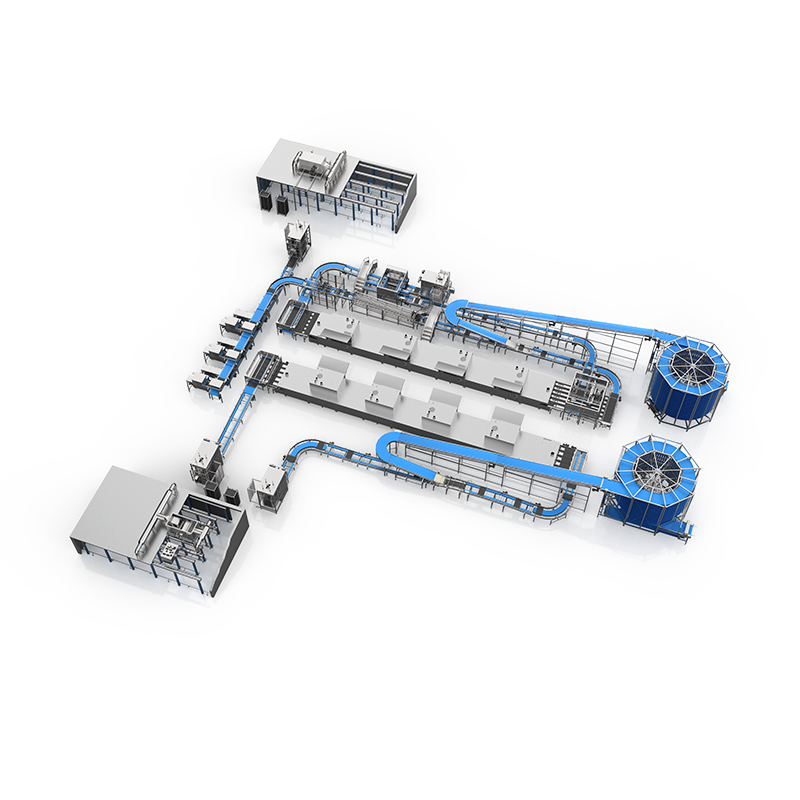
Achieving high volume is not an isolated mathematical exercise. It is strictly constrained by the physical realities of your facility floor. A common procurement error is purchasing a high-speed system that exceeds available linear floor space. This results in compromised layouts that hinder operator access. Production managers must balance target volume with spatial geometry. Look for L-shape, U-shape, or Z-shape line configurations that utilize right-angle transfers to maintain high-speed lamination within a compact footprint.
Capital expenditures in industrial baking are long-term commitments. Future-proofing your equipment involves selecting systems with open-architecture software and scalable hardware frames. Ensuring the initial control panel has spare input and output ports protects your production capabilities against shifting market trends.
Maximizing throughput requires looking past surface-level speed claims. You must analyze the granular working widths, cutting mechanisms, servo integrations, and modular capabilities of the equipment. Reviewing technical data sheets with an engineer's critical eye will help you find the perfect machinery fit.
Ready to eliminate bottlenecks and consistently hit your target pieces-per-hour? Evaluate your current floor plan and explore modular, high-efficiency equipment designed for true industrial scaling. Visit Kenxin Tech to find the exact automated machinery tailored to your volume demands and product specifications.
FAQ
What is a good throughput rate for an industrial Croissant Production Line?
Throughput varies greatly by machine size, roller working width, and individual product weight. Entry-level automated setups designed for mid-sized commercial operations typically produce 3,000 to 5,000 pieces per hour. Heavy-duty industrial lines equipped with multi-roller laminators and wide-band cutting stations can easily exceed 30,000 to 50,000 pieces per hour. Evaluating your target volume against the machine's strokes per minute is essential to determine the right fit.
Can a Croissant Maker be used for other types of pastries?
Yes. High-quality commercial bakery setups are engineered to be highly modular and versatile. By utilizing the same primary dough sheeting and laminating backbone, operators can change the cutting rollers and makeup tools. This allows a single line to produce a wide variety of laminated goods, including pain au chocolat, fruit danishes, puff pastry squares, and cinnamon rolls.
How does dough resting time affect the throughput of a Croissant Production Line?
Laminated dough requires adequate resting periods to relax the gluten network between intensive rolling stages. Without it, the dough will shrink and tear. Automated systems address this biological necessity without sacrificing volume by integrating overhead resting conveyors or vertical spiral resting systems. These components allow the dough band to rest continuously while moving.
Can I integrate a croissant curling unit into my existing Bread Production Line?
Often, yes. Many industrial manufacturers design universal dough sheeting lines based on standardized modular architectures. If your current bread setup features a compatible lamination and sheeting section with integrated PLC controls, you may only need to invest in the specific rotary cutting and curling makeup modules. This approach significantly reduces capital expenditure.
Why are servo motors important for automated production?
Servo motors provide precise, closed-loop programmable control over the speed, tension, and positioning of conveyor belts and rotary cutters. This exact kinematic synchronization ensures that as the delicate dough transfers between different sections of the machine, it does not stretch or bunch up. Preventing this mechanical distortion at high speeds is the absolute key to maintaining maximum volume.
How do you calculate the true ROI of a high-speed pastry line?
True ROI goes beyond the initial purchase price and theoretical maximum output. Facility managers must calculate the reduction in labor costs, the decrease in dough scrap due to precision cutting, and the time saved during automated recipe changeovers. Factoring in OEE and sanitation downtime provides a much more accurate picture of how quickly the machine will pay for itself.
What causes the accordion effect in dough sheeting, and how can it be fixed?
The accordion effect occurs when there is a slight speed mismatch between two cascading conveyor belts. If the receiving belt is moving even fractionally slower than the feeding belt, the dough band bunches up like an accordion. This alters the weight of the pastry and causes jams. It is fixed by upgrading to servo-driven motors linked to a central PLC, which automatically synchronizes belt speeds in real-time.