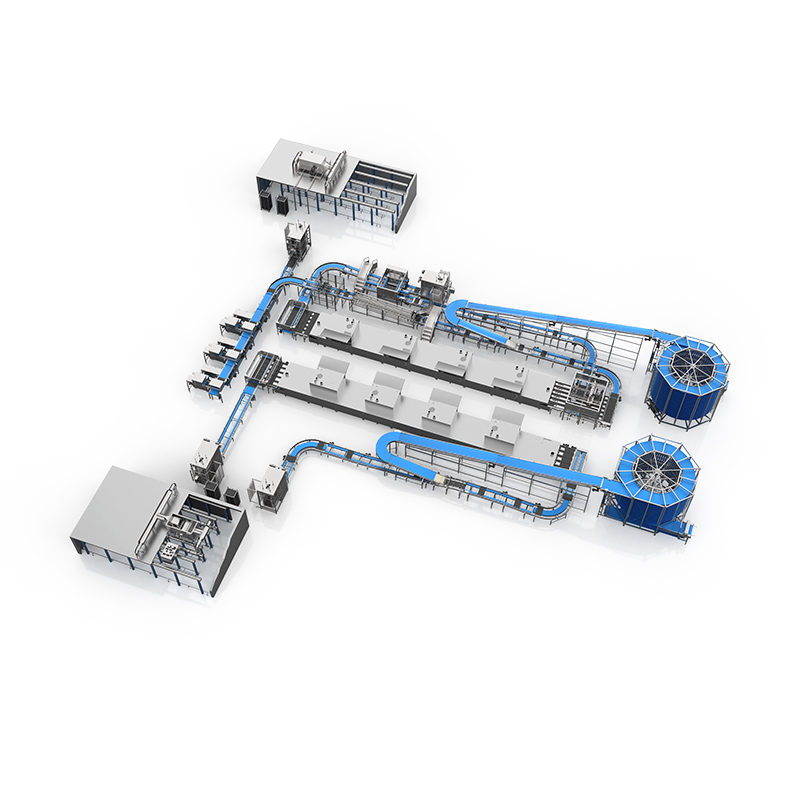
Transitioning from artisan batch production to industrial-scale manufacturing presents a complex operational challenge. Bakers must preserve the delicate alternating matrix of dough and fat. They must achieve this without causing mechanical shear degradation. Producing consistent, airy layers at scale demands extreme precision. Plant managers, industrial bakery operations directors, and capex procurement committees face tough decisions. They evaluate automated laminating and make-up machinery regularly. A poorly chosen system risks ruining product quality. Understanding the core mechanics behind these automated systems is absolutely essential. We will deconstruct the end-to-end mechanical process step by step. You will learn how to evaluate critical process control points effectively. We will compare modular and high-speed line architectures side-by-side. Finally, we will outline the specific technical criteria required to select a highly reliable commercial-grade Industrial Croissant Production Line.
Key Takeaways
An industrial croissant line relies on continuous stress-free dough sheeting and precise fat synchronization to produce consistent multi-layer structures at high speeds.
Thermal management—specifically controlling dough and fat temperatures across sheeting stations—is the single largest factor determining crumb open-structure and lamination integrity.
Automation choices (mechanical gear-driven vs. multi-axis servo synchronization) directly dictate scrap rates, changeover times, and weight deviation.
Evaluating a line requires assessing sanitary design (EHEDG/3-A standards), washdown ratings, and integration capabilities with upstream mixers and downstream proofer/freezer systems.
Production risks center on butter melt, dough tension fatigue, and high waste margins during triangular cutting; mitigate these via dough-resting belts and inline edge-trim recycling.
1. The End-to-End Mechanics of an Industrial Croissant Production Line
Continuous Dough Preparation & Extrusion
The process begins inside the mixing room. High-capacity spiral or continuous mixers handle the initial dough development. They feed large resting hoppers automatically. These hoppers utilize advanced level sensors. The sensors monitor dough volume constantly. They prevent hopper overflows or empty runs. Low-stress chunkers then take over. Some facilities use star-wheel extruders instead. These machines form a continuous dough band. They operate gently to prevent tearing. They protect the fragile gluten development completely. Maintaining a uniform dough band here guarantees downstream stability.
Automated Fat Delivery & Continuous Encapsulation
Next, the system introduces the fat layer. Temperature-conditioned fat pumps play a vital role here. Many lines use dedicated margarine or butter extruders. They deposit a calibrated ribbon of fat. This fat rests directly onto the moving dough band. Precision is critical at this stage. Folding shoes guide the dough edges. Some modern lines use pneumatic guides. They fold the dough margins smoothly over the fat sheet. This achieves complete fat encapsulation. It prevents messy edge blowouts during later pressing stages. Proper encapsulation secures the lamination matrix.
Multi-Stage Laminating and Reductions
The encapsulated block moves into the reduction phase. The line executes this through several distinct mechanical stages:
Satellite Rollers: These planetary roller heads provide progressive thickness reduction. They rotate rapidly to press the dough safely. They avoid excessive gluten tension. This prevents structural rupture in the dough.
Cross-Rollers: The sheet enters transverse rolling units next. These rollers restore dough elasticity immediately. They standardize the sheet width across the entire conveyor belt. They ensure uniform dimensions before folding.
Laminating/Folding Mechanisms: The system folds the dough to create layers. Reciprocating lappers swing back and forth. Alternatively, overlapping folding belts perform this task. They generate the precise target layer count. Bakers typically target 16 to 55 layers. The final number depends entirely on the product profile.
Dough Make-Up: Gauge Rollers, Cutting, and Curling
The fully laminated sheet enters the make-up section. Final gauge rollers press the dough one last time. They bring the sheet to a precise target thickness. This usually measures between 2.5 mm and 4.0 mm. Longitudinal slitters cut the sheet into long strips. Rotating circular blades handle this continuous slicing. Servo-driven guillotines then shear the strips laterally. They create perfectly uniform isosceles triangles. Speed-differential conveyor belts take control next. They separate the triangles quickly. They orient them either point-first or base-first. Finally, the triangles reach the curling units. Vacuum belts or motorized belts grip the dough. They stretch the triangles slightly. They roll them into uniform cylinders. They create symmetrically spiraled shapes with precise lap tension.
Downstream Integration Points
The formed croissants leave the curling belts rapidly. Alignment conveyors catch them immediately. They feed the units directly into automated panning systems. Some facilities use continuous tunnel proofers instead. Other plants route them to impingement ovens for direct baking. Frozen programs require a different path entirely. They send the raw units to spiral blast freezers. This prepares them for unbaked or par-baked wholesale distribution.
2. Engineering Variables: Controlling Lamination Integrity at High Throughput
Thermal Regulation Across Belts and Rollers
Temperature dictates lamination success. We call this the butter challenge. Real butter demands strict thermal envelopes. The ideal range sits between 14°C and 18°C. Warm butter melts into the dough layers. It destroys the flaky texture entirely. Cold butter shatters under roller pressure. It punctures the dough and ruins gas retention. System countermeasures solve these temperature problems. Facilities install climate-controlled production enclosures. They enclose the entire line in a cool cabin. Equipment manufacturers provide chilled sheeting rollers. These rollers use internal liquid-cooling systems. Intermediate cooling tunnels also help. They chill the dough between heavy folding stages.
Stress-Free Sheeting vs. Mechanical Compression
Dough compression requires careful management. High compression ratios destroy gas retention instantly. Excessive force damages fragile cell walls. It crushes the honeycomb structure. This results in dense, bread-like baked goods. Nobody wants a heavy croissant. Engineers use multi-step reduction logic to avoid this. They split the total reduction into small increments. A typical pass reduces thickness by only 15% to 30%. This gradual approach preserves the cellular matrix. It ensures uniform crumb honeycomb cell development. It guarantees a light, airy final product.
Fat-to-Dough Rheological Synchronization
Fat and dough must behave identically. We must match fat plasticity curves with dough elongation elasticity. If the dough stretches further than the fat, tearing occurs. If the fat is too soft, it squishes out. Modern machines solve this with smart technology. They use sensor-driven feedback loops. Optical sensors measure the continuous dough sheet speed. They send real-time data to the main computer. The system automatically modulates the fat-pump discharge volume. This eliminates ratio drift completely. You always get the exact fat percentage required.
3. System Architecture Comparison: Modular Lines vs. High-Speed Dedicated Systems
Modular Make-Up Lines
Modular architectures offer incredible flexibility. They suit mid-sized wholesale bakeries perfectly. These bakeries usually produce mixed product catalogs. They switch between croissants, Danishes, puff pastry, and strudels. Core characteristics include quick-change cutting modules. Operators swap these out in minutes. The curling tools operate manually or semi-automatically. Throughput capabilities range between 2,000 and 10,000 units per hour. There are some distinct trade-offs to consider. They require lower initial capital expenditure. However, they demand higher operator oversight. They also exhibit longer changeover downtime between product runs.
High-Speed Continuous Industrial Lines
High-speed systems prioritize massive volume. They serve large-scale Tier-1 industrial bakeries exclusively. Co-packers supplying commercial retail chains rely on them. Fully enclosed servo-driven architectures define these machines. They feature automated scrap reclamation systems. They include fully automated tray-loading and racking. Capacities routinely exceed 20,000 units per hour. Many push past 50,000 units per hour. The trade-offs differ from modular systems. They require a much higher capital investment. They consume a substantial facility footprint. Downtime costs per minute are significantly higher.
Line Architecture Comparison Chart
Feature
Modular Make-Up Lines
High-Speed Dedicated Lines
Target Facility
Mid-sized wholesale bakeries
Tier-1 industrial & co-packers
Product Catalog
Mixed (Croissants, Danishes, Puff Pastry)
Highly specialized, low variety
Throughput
2,000 to 10,000 units/hour
20,000 to 50,000+ units/hour
Changeover Speed
Moderate (manual module swaps)
Fast (servo-driven presets)
Operator Oversight
High (requires manual adjustments)
Low (automated telemetry)
4. Key Procurement and Evaluation Criteria for Industrial Lines
Mechanical Accuracy and Waste Control
Profitability hinges on reducing material waste. Scrap recovery systems are non-negotiable for large operations. They gather continuous side-trim automatically. They return this dough to the extruder immediately. You must evaluate this rework process carefully. High rework percentages can alter the final baked texture. The gluten networks become overworked. Weight consistency represents another critical metric. You must verify tolerances across all production lanes. A good line targets a standard deviation below ±1.0 g per piece. It maintains this accuracy across 8 to 24 separate lanes.
Sanitary Design and Compliance Standards
Food safety compliance drives modern equipment engineering. You cannot overlook sanitary design.
Material Specifications: Look for AISI 304 stainless steel. Use AISI 316 stainless steel at all direct product contact zones.
Washdown Readiness: Dry zones require an IP65 rating minimum. Direct wet-cleaning stations need IP66 or IP69K ratings.
Regulatory Compliance: Verify adherence to EHEDG, FDA, or 3-A sanitary guidelines.
Architectural Design: Demand an open-frame layout. This minimizes flat horizontal surfaces. It eliminates hollow tubing and exposed cabling. It prevents microbial harboring entirely.
Automation, Controls, and Industry 4.0 Telemetry
Modern equipment runs on advanced data networks. A central PLC system acts as the brain. Brands like Siemens or Rockwell/Allen-Bradley dominate this space. They feature multi-touch HMIs for recipe management. Operators store lamination speeds effortlessly. They save cut lengths and roller gaps instantly. Individual servo-drive architecture powers each axis separately. This allows real-time speed adjustments dynamically. It prevents dough stretching along belt transitions. It stops dough bunching immediately. Predictive maintenance features provide massive value. Vibration monitoring on main drives prevents catastrophic failures. Automated thermal logging ensures recipe compliance.
5. Implementation Realities and Operational Risks
Facility Preparation and Utility Requirements
Installing massive machinery requires intense facility planning. You must evaluate your spatial footprint early. Compare linear layouts against U-shaped designs. L-shaped layouts often fit tight plant constraints better. Environmental controls demand serious attention. Your plant HVAC capacity must handle strict parameters. It must maintain ambient humidity below 50% RH. It must hold ambient temperature zones between 18°C and 20°C. Utilities require specialized connections. Air quality requirements mandate oil-free, dry instrument air for pneumatics. Washdown drainage requires sloped floors and heavy-duty trench drains.
Commissioning, Acceptance Testing, and Training
Testing validates the equipment before full production. Factory Acceptance Testing (FAT) establishes baseline performance. You must run full-speed trials during FAT. You must use actual commercial ingredients. Water-dough substitutes do not behave like butter dough. Site Acceptance Testing (SAT) happens at your facility. It establishes verifiable run times. A standard SAT includes an 8-hour continuous run. This measures OEE under standard operating conditions. It tracks actual scrap rates accurately. Operator ramp-up dictates early success. Teams need specific technical skill requirements. They must calibrate optical sensors perfectly. They must adjust curling tension precisely. They must sanitize cutting dies safely.
Maintenance and Risk Mitigation
Machinery degrades without proactive care. Wear-part life cycles dictate maintenance schedules. High-frequency components fail first. Conveyor belts stretch over time. Scraper blades lose their sharp edges. Guillotine seals degrade under pressure. Rotating cutter bearings wear out constantly. You must track these components relentlessly. Preventative maintenance scheduling minimizes unexpected breakdowns. Teams execute daily sanitation protocols rigorously. Maintenance crews perform weekly mechanical alignment inspections. They ensure belts track straight. They verify roller gaps remain perfectly parallel. These proactive steps eliminate massive operational risks.
Conclusion
Moving from manual baking to automated production requires immense precision. We explored the mechanical progression in detail. It starts with bulk extrusion and ends with high-speed curling. Every step demands strict process control. Equipment selection must match your specific target product formulation. Handling butter differs vastly from handling shortening. Volume demands also dictate your architectural choices. You must align your machinery with your actual production goals.
Here are your action-oriented next steps:
Audit your current production line volume requirements completely.
Map your facility dimensional limitations and utility capacities accurately.
Establish strict standard deviation targets for piece weight consistency.
Q: What is the typical capacity range of an industrial croissant production line?
A: Industrial make-up lines vary widely in output. Entry-level automated setups produce 2,000 to 5,000 pieces per hour. Larger facilities require much higher throughput to remain competitive. Multi-lane, high-speed lines exceed 30,000 to 50,000 units per hour. The exact capacity always depends on product dimensions. Final piece weight also heavily influences total output capabilities.
Q: How does an automated line handle real butter compared to laminated margarine?
A: Real butter has a narrow plasticity window. It softens around 28°C to 32°C. It hardens rapidly below 15°C. Running high-percentage butter requires specialized line features. Operators use chilled rolling surfaces constantly. They enclose the line in climate-controlled cabins. They employ stress-free laminators. Vegetable margarines are much more structurally forgiving. They handle continuous sheeting easily without melting prematurely.
Q: What is the typical trim/scrap waste percentage on an industrial croissant make-up line?
A: Cutting isosceles triangles from a rectangular sheet creates waste inevitably. Inherent edge trim typically runs between 5% and 15%. Inter-triangle trim adds to this volume. High-efficiency industrial systems minimize this loss effectively. They include inline scrap conveyors. These conveyors immediately return non-compressed edge trims. They feed the dough back to the extruder. This process preserves the batch formula.
Q: What causes irregular curling or asymmetrical croissant tips during automated production?
A: Asymmetry usually stems from uneven dough sheet tension. Improper triangle positioning before the curling station causes serious issues. Miscalibrated belt pressure on curling belts also distorts shapes. Operators must ensure precise tension relaxation continuously. They use resting tables to achieve this. Servo-guided alignment stops prior to curling also solve this issue. They ensure perfect positioning every single time.