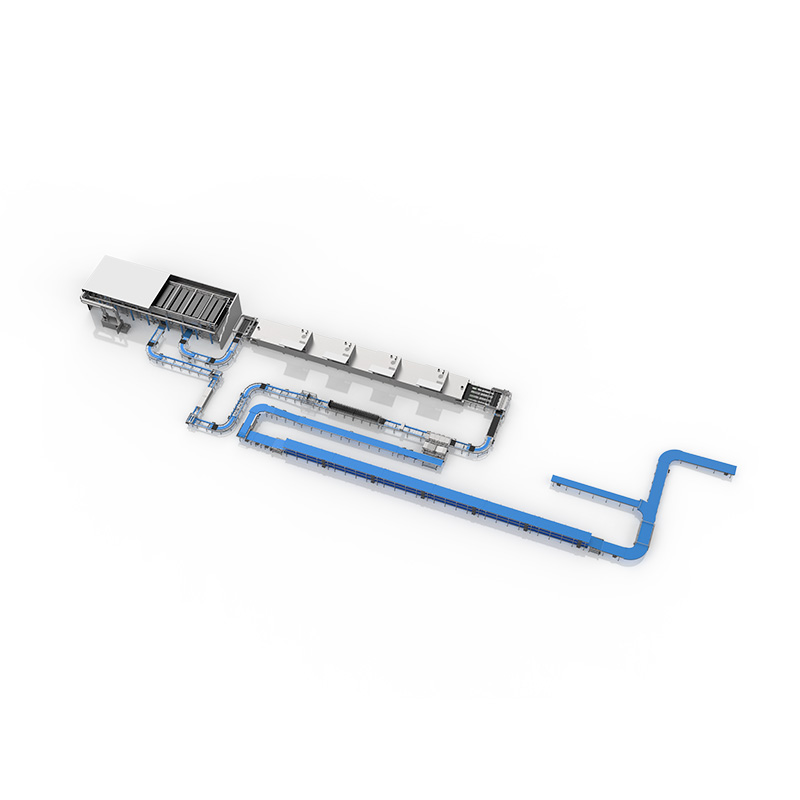
Upgrading a bakery facility is a massive financial commitment. Choosing the wrong machinery will quickly drain your profit margins. As an engineer who has overseen numerous plant expansions, I can tell you that capacity dictates everything. Your target throughput directly impacts floor space, labor overhead, and your ultimate return on investment. If you are investing in new infrastructure, getting your target throughput right is the most critical operational decision you will make.
Whether you are moving away from semi-manual processes or engineering a massive industrial facility, understanding how to calculate and optimize your production capacity is essential. This technical guide will walk you through the exact engineering steps needed to size your facility perfectly.
Key Takeaways
Throughput varies by scale: Commercial output typically ranges from 500 loaves per hour for mid-sized bakeries to over 10,000 loaves per hour for industrial giants.
Calculate based on peak demand: Always target a throughput capable of handling your peak seasonal demand within an 8-to-10-hour shift. You must leave adequate room for maintenance downtime.
Automation is the key to scaling: Transitioning to automated machinery drastically reduces labor overhead. It also ensures consistent product quality at high volumes.
Bottlenecks happen at the end of the line: Cooling, slicing, and packaging are the most common areas that slow down a high-capacity facility.
Flexibility matters: Specialized equipment requires highly specific throughput calculations due to unique shaping, scoring, and baking times.
Defining Throughput in Commercial Baking
Throughput serves as the foundational metric defining the processing capability of your baking equipment. Quantified either by individual loaves per hour or total dough weight processed, mastering this figure is your critical first step in facility planning.
For procurement teams and bakery owners, knowing this exact requirement before approaching manufacturers is a non-negotiable prerequisite. Overestimating your needs leads to wasted capital expenditure on oversized machines that sit idle for half the day. Conversely, underestimating capacity results in overworked equipment. This causes frequent mechanical breakdowns and missed wholesale delivery quotas.
When evaluating machinery, you must distinguish between nameplate capacity and operational capacity. Nameplate capacity represents the theoretical maximum output under flawless laboratory conditions. Operational capacity reflects realistic daily output on the factory floor. It accounts for shift changes, daily sanitation, and minor mechanical pauses. Major equipment decisions should always be grounded in operational capacity.
Industry Trends Shaping Capacity Planning
Before locking in your equipment size, it is crucial to analyze where the commercial baking sector is heading. We are seeing a massive shift toward high-hydration, clean-label artisan breads. Consumers demand premium textures, but these sticky doughs are notoriously difficult to process at high speeds.
Furthermore, the global shortage of skilled bakery labor is forcing facilities to automate much earlier in their growth cycle. Modern facilities are no longer just scaling up for raw volume. They are investing in versatile automation capable of handling diverse dough types without sacrificing linear speed. If your sales are growing steadily, purchasing a machine that merely meets today's demand will render your entire line obsolete within two years. Therefore, modern capacity planning must prioritize modular designs that allow for future expansion.
Typical Throughput Benchmarks
To accurately determine your target, it helps to benchmark your operations against standard industry tiers. Identifying where your business currently stands will directly guide your equipment sizing when investing in Commercial bakery production lines.
Operation Scale
Target Throughput
Equipment Setup
Primary Bottleneck Risk
Entry-Level Wholesale
500 to 1,500 loaves/hr
Semi-auto dividers, Rack Ovens
Manual panning and oven loading
Mid-Sized Industrial
2,000 to 5,000 loaves/hr
Fully automated makeup, Tunnel Ovens
Cooling spiral capacity
Large-Scale Plant
6,000 to 10,000+ loaves/hr
Continuous inline systems, Multi-zone baking
Packaging and slicing synchronization
For regional bakeries transitioning to wholesale distribution, targeting up to 1,500 loaves per hour is standard. Achieving this requires automated dough dividing and panning. In contrast, national distributors require highly synchronized, continuous systems. At this colossal scale, automated inline proofing systems and multi-zone tunnel ovens operate seamlessly without human intervention.
Key Factors That Dictate Your Target Throughput
Setting a target capacity is a rigorous engineering calculation. It demands a deep analysis of internal operational constraints intertwined with external market variables.
Your current sales volume is merely a baseline. Always calculate your projected peak seasonal demand and use that elevated figure as your absolute minimum target. Physics strictly dictates bakery layouts. Higher throughput directly correlates to a significantly larger equipment footprint. Processing 4,000 loaves an hour requires extended proofing enclosures, wider tunnel ovens, and massive ambient cooling spirals. Facility managers must meticulously calculate available square footage, ceiling height for cooling towers, and structural floor load capacities.
Specifically, the number of shifts your facility runs drastically alters your hourly machinery requirements. Producing 20,000 loaves a day requires a heavy-duty throughput of 2,500 loaves per hour if you are only running a single 8-hour shift. However, if the facility operates on two 8-hour shifts, the hourly requirement drops to a manageable 1,250 loaves per hour. Balancing upfront equipment costs against ongoing labor premiums remains a core financial strategy.
How to Calculate the Exact Capacity Your Bread Production Line Needs
Mathematical precision is mandatory when sizing a Bread Production Line. Relying on rough estimates frequently leads to severe operational bottlenecks. Utilize the following engineering framework to pinpoint your exact machinery requirements.
To find your target hourly throughput, you must isolate your absolute busiest production periods. The standard formula is straightforward. Divide your weekly peak demand by the number of working days. Then, divide that daily figure by your active production hours. This gives you your target hourly throughput.
For example, if your peak holiday demand is 50,000 loaves per week across 5 working days, your daily requirement is 10,000 loaves. Assuming your shift allows for 8 active production hours excluding mandatory breaks and sanitation, your base target is 1,250 loaves per hour.
No industrial manufacturing line runs at perfect efficiency indefinitely. You must factor in Overall Equipment Effectiveness. This metric accounts for downtime, speed loss, and rejected loaves. In commercial baking, achieving a world-class effectiveness rating sits around 80 to 85 percent. Therefore, it is imperative to add a 20 percent buffer to your calculated throughput. A sudden recipe adjustment or a brief mechanical fault can easily shave 15 minutes off a shift. Your target equipment capacity should absorb these inevitable disruptions seamlessly.
The Role of Automated Toast Production Lines in Scaling Up
When throughput targets cross the threshold of 1,000 loaves per hour, relying on manual dough handling becomes financially unviable. This is precisely where transitioning to Automated toast production lines transforms from a luxury into a business survival strategy.
Manual dividing naturally results in inconsistent dough weights, leading to uneven baking profiles and packaging jams. High-end automated systems utilize advanced volumetric dough dividers and precision check-weighers. Built with 304 stainless steel and driven by Siemens Programmable Logic Controllers, these robust machines divide bulk dough into exact portions with a margin of error of less than 1 percent. They maintain this accuracy even while processing 5,000 pieces an hour. This uniform cell structure is exactly what wholesale buyers demand.
The primary financial justification for fully automated systems lies in the dramatic reduction of direct labor costs. A semi-automatic setup might rely on a frantic floor of ten operators manually loading proofers. By implementing automation, the entire sequence is monitored by just two skilled technicians via touchscreen interfaces. This massive reduction in daily operating expenses facilitates a remarkably fast return on investment.
Specialized Equipment Focus: Baguette Toast Production
Shifting consumer palates have driven demand for value-added baked goods like artisan toasts and baguette slices. When calculating capacity for these niche items, bakeries must account for unique engineering constraints.
Producing traditional baguette-style toast is fundamentally different from baking standard pan bread. The dough requires exceptionally gentle handling to preserve its open crumb structure. If your facility plans to mass-produce these items, investing in a dedicated Baguette Toast Production Line for Bakeries is essential.
These specialized lines utilize stress-free dough sheeting systems, elongated moulding plates, and automated scoring units. Because this moulding process is far more intricate than simply dropping dough into a rectangular tin, the linear speed of the conveyor belt is inherently slower. Consequently, the hourly yield of a baguette toast line will be lower than that of a standard bread line of the exact same physical length. Equipment flexibility becomes critical. Modern lines feature modular components, allowing operators to swap out specific makeup equipment while utilizing the same proofing infrastructure.
Overcoming Common Bottlenecks to Maximize Output
Achieving a staggering throughput on paper is meaningless if the physical line constantly jams on the factory floor. The overall speed of the system is entirely dictated by its slowest component. Identifying these pinch points is critical.
In commercial baking, the oven acts as the undisputed pacemaker of the entire operation. You cannot force a loaf of bread to bake faster without ruining its internal crumb development. If your tunnel oven can only process 2,000 loaves an hour, purchasing a dough divider rated for 4,000 pieces creates an immediate, disastrous bottleneck. All upstream makeup equipment must be perfectly synchronized with the oven.
The most notorious bottlenecks occur long after the bread leaves the oven. Toast must be cooled to a specific core temperature, usually around 35 to 40 degrees Celsius, before it encounters a slicing blade. Slicing warm bread causes the crumb to tear and introduces excess moisture into the packaging. Depending on factory conditions, proper cooling takes between 60 to 120 minutes. Furthermore, slicing and packaging machinery should always be rated 15 percent higher than your oven maximum output. This strategic overcapacity ensures that if a bagging machine jams, it can quickly clear the backlog of bread accumulating on the cooling conveyor.
Actionable Selection Guide for Target Capacities
Once you have meticulously calculated your required throughput, the final step is selecting an equipment vendor capable of delivering on those metrics. Buying industrial bakery equipment is a major capital expenditure. Avoid rigid, off-the-shelf solutions that force your bakery to adapt to the machine.
Prioritize manufacturers who take an engineering-first approach. The ideal production line should be inherently modular. You might install a system rated for 2,000 loaves an hour today, but it should feature the structural framework to seamlessly add a second cooling spiral later. High-throughput environments create immense mechanical stress on moving parts. Prioritize vendors who offer robust after-sales support, remote diagnostic capabilities, and guaranteed availability of standardized spare parts.
Selecting the ideal target throughput requires a delicate balance between fulfilling current demand and anticipating future growth. By doing the math carefully and leaning heavily into modern automation, bakeries can scale profitably and sustainably for decades to come.
Frequently Asked Questions
What is the minimum throughput to justify an automated toast production line?
Generally, bakeries producing upwards of 1,000 to 1,500 loaves per hour will see the fastest return on investment from fully automated lines. At this volume, the significant reductions in manual labor costs and the drastic decrease in raw material waste easily offset the initial capital expenditure.
Can one bread production line handle both standard toast and baguette toast?
Yes, but it requires highly modular equipment design. Standard sandwich bread and baguette toast require entirely different dough handling techniques. A specialized line can be engineered with interchangeable makeup equipment, allowing operators to swap out specific dividers and moulders. You must carefully factor the required changeover times into your daily throughput calculations.
How long does a commercial toast bread line take to cool the bread before slicing?
Depending on the ambient temperature of the facility and the specific density of the recipe, industrial cooling systems typically take 60 to 120 minutes. The goal is to bring the core temperature of the toast loaf down to approximately 35 degrees Celsius. This lengthy cooling duration must be accurately factored into your overall footprint calculations.
What happens if my oven capacity is higher than my packaging capacity?
This scenario creates a severe and costly bottleneck. If the oven bakes bread faster than the slicers and baggers can process it, baked goods will back up on the cooling conveyors. To prevent this, your packaging throughput should always be engineered to operate 10 to 15 percent faster than your oven maximum theoretical output.
How much buffer should I add for future business growth?
As a general engineering rule, you should size your primary infrastructure, like ovens and cooling spirals, for your projected volume three to five years from now. Adding a 20 to 30 percent buffer above your current peak demand ensures you will not outgrow your multi-million dollar investment within the first few years of operation.
Does the dough hydration rate affect my target throughput?
Absolutely. High-hydration doughs are stickier and require much gentler, stress-free handling to prevent degassing. This often means running the conveyor belts at a slower linear speed compared to stiff, low-hydration sandwich bread doughs. You must adjust your hourly piece count expectations downward when running artisan recipes.
Ready to engineer a facility that maximizes your profitability without the bottlenecks? Stop guessing your capacity requirements. Explore the highly customizable, heavy-duty machinery at Kenxintech. Whether you need a high-speed toast line or a specialized artisan bread setup, our engineering team will help you match the exact equipment parameters to your operational goals. Visit Kenxintech today to configure your ideal production line.