Transitioning to an industrial croissant operation is a delicate balancing act. You must achieve high-volume throughput. At the same time, you must preserve the artisanal dough structure to achieve the classic honeycomb crumb. Navigating the equipment market presents a major procurement challenge. You will often encounter exaggerated equipment claims from various manufacturers. The right choice depends entirely on verifiable metrics. You need consistent lamination, reliable dough handling, and modular scalability to succeed.
The purpose of this guide is to provide an evidence-oriented evaluation framework. Operations managers and bakery owners can use it to assess capacity and technical capabilities before shortlisting vendors. You will learn exactly how to define success criteria, evaluate core machine features, and mitigate implementation risks. By following this framework, you can confidently select a system tailored to your specific production environment.
Key Takeaways
Base your equipment selection on a clear assessment of your target throughput (pieces per hour) and available facility footprint.
Prioritize modular systems that guarantee consistent lamination and stress-free dough handling to protect product quality.
Evaluate Total Cost of Ownership (TCO) by factoring in sanitation downtime, maintenance requirements, and operator training, not just initial capital expenditure.
Require vendor testing with your proprietary dough formulations before finalizing any procurement decision.
Defining Success Criteria for Automated Croissant Production
Before you evaluate any machinery, you must define what success looks like for your bakery. Standardizing product quality is the first step. You need to identify the absolute non-negotiables for your end product. These include specific butter-to-dough ratios, the precise number of lamination layers, and desired volume or weight consistency. If a machine cannot meet these baseline quality metrics, you should eliminate it from consideration immediately.
Next, you must weigh labor against automation trade-offs. Map your current manual bottlenecks against modern automation capabilities. Success usually means reducing your dependency on skilled manual lamination. It also means lowering your scrap and waste percentages. A high-quality Croissant Production Line will automate the most labor-intensive steps while maintaining artisanal quality.
Yield expectations play a massive role in this evaluation. You must establish acceptable margins for dough trim and reject rates during the make-up process. High-end systems minimize edge trim and often feature automated scrap return conveyors. This keeps your yield high and your ingredient waste low.
Finally, you must acknowledge your facility readiness. Space constraints are a reality for most bakeries. Continuous automated lines require a significant linear footprint. They also demand climate-controlled environments for proper dough resting. If your facility lacks the necessary HVAC infrastructure or floor space, you will struggle to operate an industrial line effectively.
Define Quality Metrics: Document your required layer count, butter ratio, and baked volume.
Map Labor Bottlenecks: Identify where manual handling slows down your current output.
Set Yield Targets: Determine your maximum acceptable percentage for dough trim and rejects.
Audit Facility Space: Measure your available linear floor space and assess your climate control capabilities.
Assessing Throughput and Scalability Requirements
Understanding your capacity needs is critical when selecting equipment. You must differentiate between your current output and your future growth projections. Commercial or mid-scale operations typically require 3,000 to 5,000 pieces per hour. Heavy industrial output demands 20,000 or more pieces per hour. Purchasing a machine that barely meets your current needs will stifle your growth. Conversely, overbuying capacity can strain your capital unnecessarily.
Line modularity is another crucial evaluation metric. You should evaluate vendors based on their upgrade paths. Ask yourself if you can add automated proofing, cooling, or packaging modules later. You want to expand your capabilities without replacing the core make-up line. Modular systems allow you to scale your investment alongside your revenue.
Product versatility determines how agile your bakery can be. Assess the changeover time required to switch from standard croissants to pain au chocolat, mini-croissants, or filled pastries. A reliable line must minimize downtime between different SKUs. Quick-change tooling and recipe-driven software interfaces are essential features for versatile production.
Table: Mid-Scale vs. Heavy Industrial Production Requirements
Requirement Category
Mid-Scale Production
Heavy Industrial Production
Target Throughput
3,000 – 5,000 pieces/hour
20,000+ pieces/hour
Footprint
Compact to medium linear space
Extensive linear space (often 30m+)
Modularity Focus
Interchangeable cutting/curling tools
Fully integrated proofing and freezing
Changeover Speed
Manual tool swaps (15-30 mins)
Automated/Tool-less swaps (<10 mins)
Evaluating Core Features: Consistent Lamination and Dough Handling
The heart of any pastry operation is the lamination process. Stress-free dough processing is non-negotiable. You must scrutinize the extruder and sheeting mechanisms closely. Look for systems that actively reduce dough tension. Satellite rollers and cross rollers help preserve yeast integrity and delicate gluten networks. If a machine punishes the dough, your final baked product will lack volume and texture.
The lamination mechanism itself requires deep evaluation. Check the precision of the fat pump and the folding stations. Consistent lamination prevents butter smearing. It ensures distinct, even layers throughout the pastry. A high-quality fat pump extrudes a perfectly uniform sheet of butter. The folding arms must then encapsulate this butter without trapping excess air or tearing the dough band.
Industrial processing naturally generates friction and heat. Because of this, integrated resting and cooling systems are vital. Verify that the line includes adequate resting belts and cooling tunnels. These components maintain optimal dough and fat temperatures during the lamination phase. If the butter melts into the dough, you lose the honeycomb structure entirely. Proper resting also allows the gluten network to relax, preventing shrinkage during the cutting phase.
Cutting and rolling accuracy directly impacts your final product appearance. Review the stamping, cutting, and curling units carefully. Pinpoint accuracy here prevents misshapen products. It also ensures uniform baking times in the oven. Advanced curling units use vacuum belts and precise mechanical arms to roll the dough tightly and consistently, mimicking the motion of a skilled baker's hands.
Analyzing the Equipment Modules of a Croissant Production Line
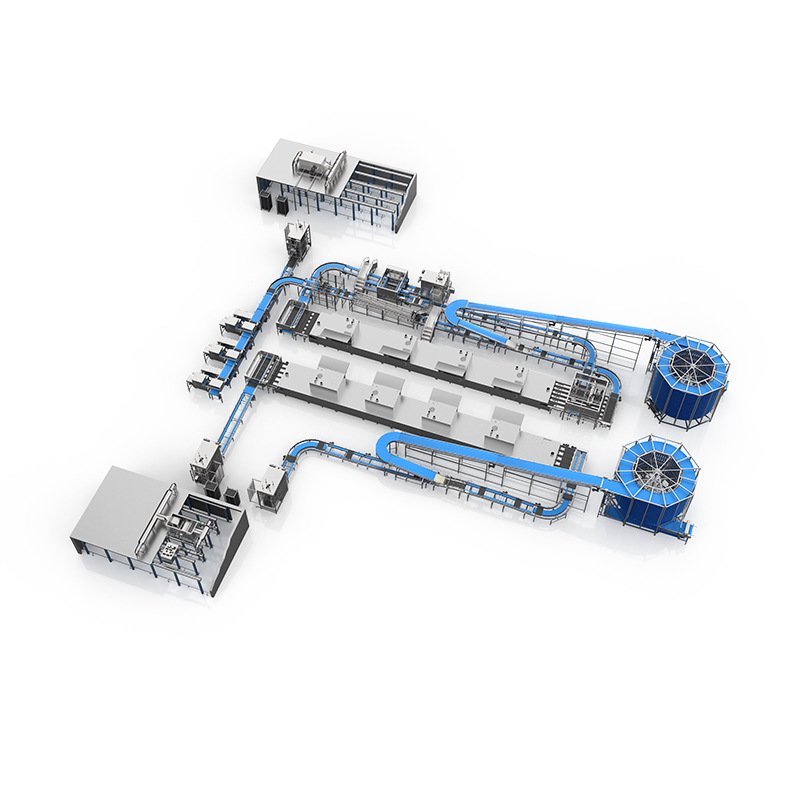
A complete Croissant Production Line consists of several distinct modules working in harmony. Understanding these modules helps you evaluate the overall system architecture.
Dough Preparation & Sheeting: This is the front-end equipment. It is required to mix, extrude, and form the initial continuous dough band. The goal here is to create a uniform, stress-free sheet of dough ready for fat incorporation.
Fat Incorporation & Lamination: These specialized blocks fold the dough and fat into the required number of layers. Depending on your recipe, this might be 16, 24, or 64 layers. The laminator uses swing arms or overlapping mechanisms to build these layers gently.
Make-up Line (Cutting & Forming): These modular stations cut the laminated dough into triangles. They apply the necessary tension and roll the dough into the classic crescent or straight shapes. Precision guillotines and stamping dies operate here.
Downstream Integration: You must consider how the make-up line connects to the rest of your bakery. This includes automated proofers, continuous baking ovens, and freezing or cooling spirals. Seamless integration prevents bottlenecks at the end of the line.
Each module must communicate flawlessly with the others. Centralized PLC (Programmable Logic Controller) systems allow operators to adjust belt speeds and roller gaps across the entire line from a single touchscreen. This synchronization prevents dough bunching and tearing between modules.
Implementation Risks and Compliance
Deploying a new industrial line introduces several operational challenges. Hygienic design and sanitation should be at the top of your risk assessment list. You must evaluate the ease of cleaning for every module. Look for tool-less belt removal and wash-down safe components. The machine should have minimal catch-points for debris. Adhering to strict food safety compliance is much easier when the equipment is designed for rapid, thorough sanitation.
Maintenance and parts availability can make or break your production schedule. Assess the vendor’s global and local support network before buying. Proprietary, hard-to-source parts increase the risk of extended production downtime. You want a machine built with standard, commercially available motors, sensors, and bearings whenever possible. This ensures your local maintenance team can source replacements quickly.
Operational rollout risks are often underestimated. You must acknowledge the learning curve associated with new technology. Transitioning to a high-speed line requires intensive operator training. It often necessitates adjustments to your dough recipe as well. Hand-sheeted dough behaves differently than machine-processed dough. Your formulation may need hydration tweaks or different resting times to tolerate continuous machine processing.
To mitigate these risks, involve your maintenance and sanitation teams early in the procurement process. Their practical experience will help you spot design flaws that look fine on paper but create nightmares on the factory floor. A well-designed line protects your product quality and your operational uptime.
Conclusion
Choosing the right equipment dictates the future trajectory of your bakery. Apply strict shortlisting logic to narrow down your choices. Focus on vendors who transparently share performance data. Prioritize manufacturers who offer modular scaling and demonstrate a proven track record in your specific production tier. A vendor experienced in mid-scale bakeries might struggle to deliver a heavy industrial solution, and vice versa.
The crucial next step is physical validation. You should never purchase equipment based solely on glossy spec sheets or promotional videos. Mandate a live demonstration or a pilot test at the manufacturer’s test bakery. You must use your exact ingredients and your proprietary recipe during this test. This is the only way to validate lamination consistency and dough handling in a real-world scenario. If the machine can handle your dough perfectly during a Factory Acceptance Test (FAT), you can proceed with confidence.
FAQ
Q: How much footprint does an industrial croissant production line require?
A: It varies heavily by automation level. A semi-automated make-up line might fit in a compact space. However, a fully automated line with lamination, resting systems, and proofing can require 20 to 50+ meters of linear floor space. Always measure your facility before engaging vendors.
Q: Can one production line produce both straight and curved croissants?
A: Yes, reputable lines feature interchangeable curling and bending units. You should evaluate the estimated changeover time for these parts. Quick-change mechanisms ensure the swap aligns perfectly with your production shift schedules without causing excessive downtime.
Q: What is the difference between a dough sheeter and a full make-up line?
A: A dough sheeter only flattens and folds the dough, handling just the lamination phase. A full production line automates the entire process. It handles extruding, laminating, resting, cutting, and rolling the final product sequentially.
Q: How do automated lines handle dough scrap?
A: High-end machines utilize precise stamping and cutting tools to minimize edge trim. The remaining clean scrap is typically routed back into the initial dough feeder via an automated return conveyor. This maximizes your overall dough yield and reduces waste.